The Ultimate Guide to Building Your Own DIY Latex Mattress


DIY projects have grown from being helpful and budget-friendly to being fun. Now, it’s gone a step further – you can build your own latex sofa bed mattress from the comfort of your home without breaking the bank.
Billions of mattress combinations are available on the market, and it can be difficult to pick the perfect mattress type that suits your needs. It could be even worse if you have a partner with a different sleeping position and comfort level.
Plus, if you’re on a budget and still trying to figure out the kind of latex sofa bed mattress you want, a DIY latex mattress is the ideal option.
To make a DIY latex mattress, you’ve got to do everything yourself – from purchasing the layers of the latex mattress to stacking them together in the right order and enclosing them in a cover. Read on for a more detailed DIY organic latex mattress.
Table of Contents
- 1 What You Need to Build Your Own Latex Mattress
- 2 DIY Latex Bed Sizes
- 3 DIY Latex Mattress Firmness Levels
- 4 How to Choose the Right Firmness for a DIY Latex Bed
- 5 How to Build Your Own Latex Mattress
- 6 Factors to Consider When Choosing a Bed Frame for a Latex Mattress
- 7 Best Bed Frame for Latex Mattresses
- 8 Final Words
What You Need to Build Your Own Latex Mattress
Although different mattress materials exist, most latex-free mattresses have almost the same components. Knowing what you need within each mattress layer is crucial to building your own latex mattress.

Cover
The cover protects the mattress from contaminants like bacteria and dirt and encloses the latex mattress layers. Depending on your preferences, mattress covers can be stitched or removable. Some covers have cooling capabilities that help wick away moisture while serving as an extra plush layer.
Support Layer
The latex mattress foundation supports all the transition and comfort layers and increases the mattress’s durability. The support layer consists of just a few durable materials like coils (used in hybrid, latex, and innerspring beds) or high-density foam (used in memory foam beds).
Comfort Layers
These layers majorly affect pain, pressure relief, and temperature regulation. They have cushioning foam, mostly memory foam. If they contain cooling properties, the foams have gel or open-cell. Without cooling properties, the foam will trap heat. So, you must incorporate cooling properties into the latex mattress layers if you often over-sweat at night.
Transition Layers
These layers connect the latex mattress foundation with the comfort layers and help to transition the sleeper’s weight to the base. This setup supports the body and keeps it properly aligned so you don’t sink into the comfy comfort layer while sleeping. The transition layer could be latex, memory foam, coils, or poly foam.
Expert tip: When stacking your mattress layers, use adhesive between the layers to prevent them from slipping off when you sleep. Undoubtedly, an encased cover can serve its purpose, but an adhesive provides more protection.
DIY Latex Bed Sizes
Before you build your latex mattress, you must consider what size to make. Remember that the larger the mattress, the more material you’ll purchase. To help you decide, here’s a guide on common latex bed sizes and which sleep each is best for.
| Latex Bed Size | Dimensions (W x L) | Which Sleeper is it Best For? |
| Twin | 38” x 75” | Toddlers, Children, Single adults |
| Twin XL | 38” x 80” | Children, single adults, college students |
| King | 76” x 80” | Couples, couples with children and/or pets |
| California King | 72” x 84” | Couples, couples with children and/or pets |
| Queen | 60” x 80” | Single adults, single adults with children and/or pets, couples |
| Full | 54” x 75” | Children, single adults, single adults with children and/or pets |
DIY Latex Mattress Firmness Levels

Your latex mattress’ firmness level determines the amount of comfort you’ll enjoy. The industry standard mattress firmness level is from 10 (firmest option) to 1 (softest option).
Firm Latex Mattresses
The firmness scale of these mattresses is 8/10. They have a rigid structure and don’t give that hugging feeling as you’d expect from a memory foam. However, firm mattresses are the best option for stomach sleepers who need a sturdy mattress to raise their hips and back sleepers who need a firmer feel.
Medium-Firm Latex Mattresses
These latex mattresses are at 6/10 on the industry standard firmness scale. They offer spinal alignment and motion absorption. Hence, they’re good for back sleepers who prefer support and comfort.
Soft Latex Mattresses
Soft latex beds are a 3/10 on the firmness scale. They have well-defined cushions that provide maximum support. Unfortunately, support and firmness aren’t the same, but many firmer beds offer support because they have a stronger support layer than the comfort layer.
Additionally, soft latex-free mattresses are best for people with joint pain and side sleepers who need a soft mattress for pressure relief and optimal comfort.
How to Choose the Right Firmness for a DIY Latex Bed
The best part of a latex mattress DIY is that it’s customizable, so you can choose any mattress firmness you want. But, there are two major factors you must first consider.
Each body type and sleeping style requires varied support levels, so it’s vital to choose the firmness level based on individual preferences.
Body Type
Heavyweight side sleepers require firmer latex-free mattresses than lightweight side sleepers. Here are some common rules for the different body types:
- Heavyweight sleepers(over 250 pounds) need slightly firmer beds no matter their sleep position because they compress the bed materials more and need stronger support for proper alignment.
- Average-weight sleepers (between 130 and 250 pounds) are comfortable with a firmness level just around the middle because they barely feel the mattresses.
- Lightweight sleepers (under 130 pounds) need softer beds because their weight isn’t enough to compress the bed materials and cause pressure build-up.
Sleeping Position

There are numerous sleeping positions, but the most common are combination sleeping, stomach sleeping, back sleeping, and side sleeping.
- Combination sleeping: These sleepers turn and toss between at least two sleeping positions. Choosing latex-free mattresses that best suit these sleepers’ most common sleep position is vital. Medium-firm latex mattresses work best for multiple sleeping styles. Also, a bouncy (or responsive) bed is a great option as it allows ease of movement when changing sleeping styles.
- Stomach sleeping: The most important consideration for stomach sleepers is preventing the abdomen from sinking, which can strain the spine. Firmer mattresses are the go-to for this sleeping position.
- Back sleeping: Back sleepers need a balance of cradling for pressure relief on the hips and solid support for spinal alignment. Medium-firm beds are the best option for back sleeping.
- Side sleeping: Side sleepers feel most comfortable lying on latex mattresses that provide cushion for the hip and shoulder since those are the body parts with the most pressure for this sleeping position. So, softer beds are best for side sleepers as they help prevent joint pains.
How to Build Your Own Latex Mattress
Now that we’ve covered the basics of mattress firmness, sizes, and construction, let’s discuss how to build your own latex mattress. For easy comprehension, we’ll explain this section according to each of the four most common mattress types:
- Innerspring mattresses consist of a thinner comfort layer and some coil layers that help enhance the bed’s support. These mattresses are cooling, firmer, and bouncy (responsive).
- Memory foam mattresses: These beds consist of many foam layers. Some provide support, while others offer pressure relief. They’re the best option for people needing pressure relief or a slow-sinking feel.
- Hybrid mattresses: They combine some qualities of memory foam and innerspring mattresses. Hybrid beds have a thicker comfort layer and a solid coil layer for balanced support and comfort. However, their construction process varies from brand to brand.
- Eco-friendly mattresses: Their materials are all-natural, organic, and non-toxic. They’re popular and known for their durability, bouncy feel, and cooling properties.
After buying all the mattress materials, your DIY should cost around $500. Note that higher-quality materials are more expensive, so working with your budget is crucial.

The secret to the best affordable latex-free mattresses is the right balance between quality and price. However, a latex mattress DIY is less expensive than buying a latex sofa bed mattress in a store or online.
Just know the mattress size, the perfect firmness level, and the best materials for DIY latex mattresses.
How to Build an Innerspring Mattress
If your sleeping position and body type permit, an innerspring mattress is the easiest DIY latex bed option. It has the simplest construction process – a sturdy coil unit and one comfort layer from each side encased in the cover.
Here’s how to build your innerspring latex mattress:
- Unzip the mattress cover and spread it on the floor. A mattress protector can serve as a mattress cover. This great ready-made solution gives you a rough idea of your mattress size.
- Place the foam layer on the mattress cover. Most innerspring mattresses have comfort layers on both sides to allow for flipping. You can choose different firmness levels for each layer, but if you don’t plan to flip your mattress, opt for a denser and firmer poly foam 2 to 3 inches thick.
- Position the coil unit on the foam. The coil layer is the primary supportive structure of the bed, and it should be 6 to 7 inches high. Choose a higher coil count or thicker coils for a firmer latex bed because it creates a uniform surface and extends your bed’s longevity.
- Place the comfort layer on top. You can choose natural latex, traditional memory foam, or gel memory foam, depending on your preferences. The recommended level of thickness for the material is 2 to 3 inches. But it’s still at your discretion, depending on how thick you want your mattress. However, if you have a firm core, you should choose a softer comfort layer for balanced support.
- Wrap the bed in the mattress cover and zip it. These mattresses are 8 to 12 inches thick and may be heavy because of the coil system.
How to Build a Memory Foam Mattress
Memory foam beds have different firmness levels and can be dual-sided or standard. They have comfort layers and a firmer core that defines the final firmness.
It provides the perfect balance of firmness and pressure relief you desire in an all-foam mattress. However, it would be best to consider how slow-moving or responsive you’d like this mattress to be since the materials you use can alter its firmness.
Here’s how to build your memory foam mattress:
- Unzip the mattress cover and place the bottom half on the floor. If you intend to make a standard mattress, you can put the base foam layer on the mattress cover. The layer should be roughly 4 to 6 inches thick. If you want to build a DIY latex bed with varied firmness levels, then you need to place a 1 to 2-inch comfort layer before you secure the base with the glue.
- Position the transition layer. This layer helps ensure your spine remains neutral throughout the night. Also, it helps to distribute your weight evenly on the bed. This can be a 2-inch open-cell memory or poly foam layer.
- Secure the comfort layer. Memory foam mattresses are temperature-sensitive, so to prevent them from heat retention, you need to choose cooling foams for the comfort layers. Also, we recommend that you use 3-inches materials or less to avoid trapping too much heat.
- Allow your adhesives to dry, and zip up the mattress cover. You can now sleep on your mattress.
How to Build a Hybrid Mattress
This mattress has different support systems, including foam layers and a coil block. With the right materials, building a hybrid mattress is seamless.
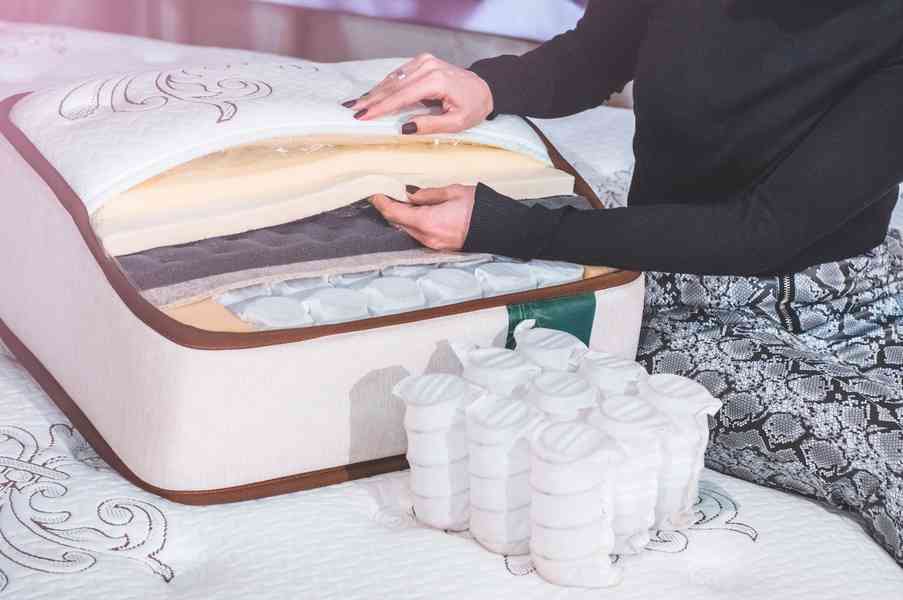
A hybrid mattress DIY can be up to 18 inches high and very high; the most important thing to focus on is its comfort layer and edge support.
Here’s how to build your hybrid latex mattress:
- Unzip the bed cover and place it on the floor. Place a thin layer of firm and dense memory foam on the bottom cover. The layer will evenly hold your coil system. Most times, hybrid mattresses are one-sided. After the core layer, you’ll need to stack layers until you reach the desired feel.
- Place the coil system on the base foam layer. You can opt for individually wrapped coils or a solid coil block. The former will require you to reinforce the perimeter with dense polyfoam, so ensure you define your mattress height before you start building.
- Position the transition layers. You can choose from a couple or a single transition layer. The best materials for this layer are synthetic latex, poly foam, and natural latex.
- Sincerely, any material that quickly restores its shape and has a good responsive (bouncy) feel works just fine.
- Position the comfort layers. A hybrid mattress has many comfort layers, but you can use just a few. You’ll need adhesive to secure the foam layers, but ensure you leave room for breathability. Use the material you love most for the upper comfort layer because it’ll be the main layer you’ll feel. If the bed is open-celled or gel-infused, it’ll be one of the best cooling mattresses.
- Wrap the mattress in its cover and zip it.
How to Build an Eco-Friendly Mattress
This mattress is the most expensive option on the market because of the high-quality materials used in its construction. But an eco-friendly latex mattress DIY will help you stay on a budget.
Here’s how to build your eco-friendly latex mattress:
- Opt for an organic cover. The best materials are bamboo, cotton, or tencel.
- Choose a plant-based or natural latex memory foam if you prefer a mattress without coils. The former allows for upcycling because they’re more eco-friendly. You can use the excess foam to build pet beds.
- If you want a mattress with coils, you can use upcycled mattress springs from your old bed if they’re still in good condition. This option will help make your mattress cheaper because brand-new spring blocks cost up to $300.
- For the cooling layers, you can use natural wool or brushed cotton. These materials are natural, and you can recycle them at the time of disposal.
- Also, you can replace adhesives with hand-stitching. However, this replacement will increase the time needed for your latex mattress DIY. So, if you don’t have enough time, you can still use adhesives; just ensure you select eco-friendly varieties.
Factors to Consider When Choosing a Bed Frame for a Latex Mattress
Your bed frame quality is just as important as your latex mattress. This is because latex beds have specific requirements due to their unique material properties. Here are the major factors to consider when picking a latex mattress bed frame:
Proper Ventilation
Latex mattresses have good breathability, which helps regulate temperature during sleep. For optimal satisfaction, choose a bed frame with slats. Ensure the slats have enough space to allow airflow, preventing moisture buildup and helping the bed remain dry and cool.
Strong Support
Latex beds are heavier than traditional spring beds. Hence, choosing a bed frame that can support the mattress’s heavy weight without breaking or sagging would be best. Settle for bed frames with robust materials like heavy-duty metal springs or solid wood. The bed frame should have a solid base that evenly distributes the sleeper’s weight on the mattress.
Size Compatibility
A latex mattress’s bed frame must match its size. A mismatch can cause the frame to stick out or a mattress overhang. Also, consider the height of the frame, as a too-low or too-high frame will affect the ease of moving in and out of bed.
No Sharp Edges
Latex beds are softer and pliable than traditional mattresses and, hence, more prone to damage from sharp edges. Ensure you get a bed frame with smoothly finished or rounded edges to avoid wear and tear on the mattress.
Aesthetic Appeal
The bed frame for your latex mattress should complete the overall bedroom aesthetic. Whether you prefer a minimalist, traditional, ornate, or modern style, various designs match your preferences and still meet the standard requirements of a latex bed.
Ease of Assembling and Movement
Consider the ease of assembling and moving the bed frame. An easy-to-move-around frame is beneficial if you move frequently. Also, frames with features like lockable wheels are the real deal.
Minimal Flex
Minimal flex in a bed frame for a latex mattress provides comfort, but too much can affect the bed’s support. Overly flexible frames can change the mattress’s feel and cause discomfort or back pain.
Best Bed Frame for Latex Mattresses
Latex beds require a mattress foundation or bed frame under 3 inches between the slats to qualify for the Mattress Warranty. If the slats are too close, but the space between them exceeds 3 inches, you can use coir pads, pegboard, or plywood with ventilation holes to fix the gaps.
The general rule is that every slat system should have more support than air and a standard setup of a 2″ slat spacing with a 3” wide slat.
Mattress foundations play a vital role in latex mattresses, which, if ignored, will result in disappointing outcomes. We recommend choosing a foundation for latex mattresses or a firm, well-supported bed frame.
Organic latex-free mattresses are highly sensitive to their foundation. So, the bed frame’s slat spacing, shape, and thickness can alter the mattress’s feel.
Spring mattress manufacturers don’t make the best foundation for latex mattresses. That’s because they barely satisfy latex support requirements, and you must confirm the support structure for warranty coverage.
Final Words
Building a DIY organic latex mattress may seem tedious, but it’s just a matter of proper planning. If you define the mattress construction process, choose good quality materials, and devote some time to the latex mattress DIY, you’ll build your own dream mattress in no time.
Building a DIY latex bed allows you to create an exceptionally comfortable, hygienic, and long-lasting latex mattress. Plus, you are certain of a solid return on investment (ROI). Get it together and build your own latex mattress today!